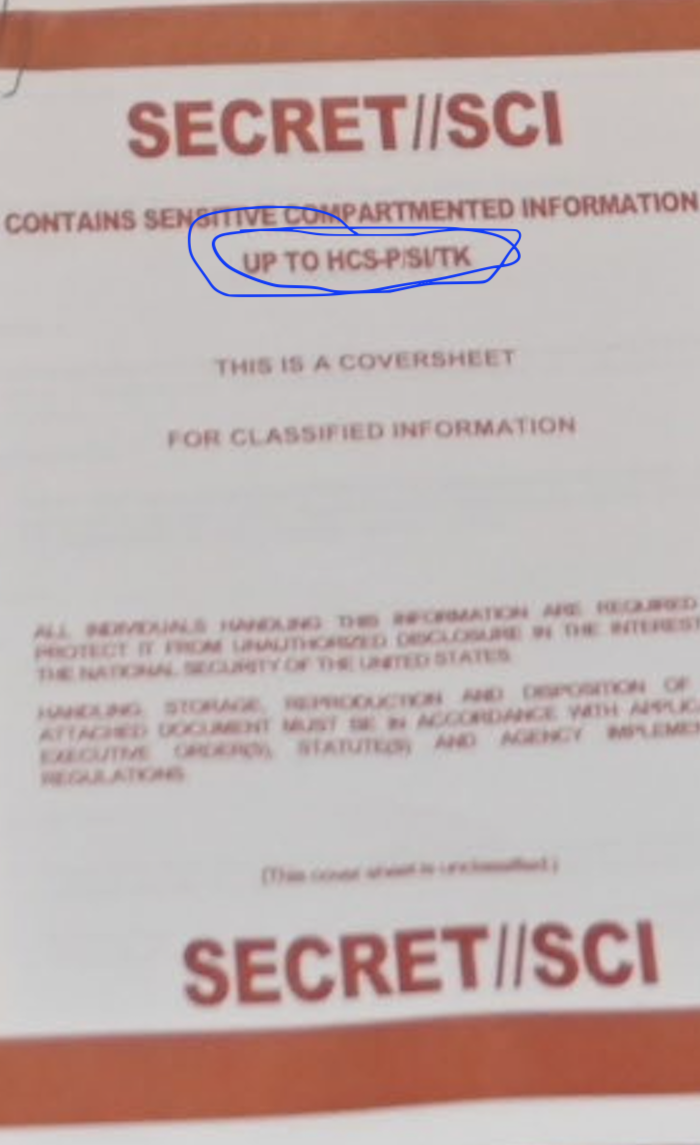
This is a brief explanation of the weird acronyms on the cover sheets that appeared in the photo of classified the FBI seized at Trump’s Mar-a-Lago home. They identify different types of classified information that might – or might not – reside beneath such a cover sheet.
The traditional classification markings Confidential, Secret, and Top Secret, refer to two things. First, they refer to the degree of damage to national defense that might be caused by leaking the information so marked. Second, they imply the depth of investigation a person must endure to get permission to see such documents.
Sensitive compartmented information (SCI) uses compartmentalization to protect sensitive information. Separate compartments are created to hold information of different kinds. People are granted access to as few compartments as is practical and people can only leak information from compartments they can access. The concept tries to minimize the risk posed by individual spies or other leakers while granting access to people who need access to do their work.
The markings HCS, SI, and TK refer to control systems (a.k.a. control channels) for different types of SCI. These are independent layers of bureaucracy intended to protect specific kinds of classified information. These systems allow separate organizations to directly manage the classification and distribution of the information they collect and the details of how they collect it.
HCS stands for Humint Control System, where “Humint” refers to information collected by human data collectors. The word is an awkward contraction of “Human Intelligence.” This type of intelligence poses special risks since the people collecting the data may be acting illegally, and be vulnerable to arrest or execution if detected.
HCS-P refers to intelligence products while HCS-O refers to information about operations. A “product” is a classified report that has been sanitized to reduce the risk of identifying the human source. If the report still carries the HCS marking after sanitization, then the authors believe the report still contains too much information to keep the source safe from harm. “Operations” refers to information used in managing human sources. Such information almost certainly discloses information that could put sources at risk.
SI stands for Special Intelligence, which in general refers to intelligence collected from intercepted communications signals. This is also called “Comint” and “Sigint,” to give it similar names to “Humint.” Special Intelligence is largely the domain of the National Security Agency (NSA).
TK is an acronym build from formerly secret codewords “Talent” and “Keyhole.” These originally referred to intelligence collected from aerial photographs. Talent photographs are collected by aircraft, while Keyhole photographs are collected by satellites. TK information now includes most satellite intelligence.
The intelligence community emphasizes the secrecy of sources and methods: the tools, techniques, and people they use to do their work. Federal laws specifically protect the secrecy of sources and methods, independent of the Espionage Act.
The “Plame Affair” illustrates this: a syndicated political columnist reported that the wife of a US diplomat, Valerie Plame, was a clandestine CIA agent a few days after her husband published an editorial criticizing the President’s decision to invade Iraq. As often happens, the only administration official convicted of violating a law was someone who tried to cover up the affair by lying to government investigators. The person who actually leaked Plame’s CIA role was never identified conclusively. Some Washington insiders suggested that Plame’s role was a well-known rumor that spread within the Capital Beltway. (As someone who grew up in that area, I can attest that almost everyone has been rumored to be a CIA agent. Me. Our neighbors. The guys at Pizza Supreme.)
 Cryptosmith
Response
[…] leaked by the cover itself. Although the sheet says it “may include information up to “HCS-P/SI/TK,” it doesn’t disclose such information. Those abbreviations are unclassified. For […]
LikeLike